UAE FinTech Companies ‘Seizing the Opportunity’ of Agentic AI to Solve More Complex Business Problems, say Experts
JetBrains convenes MENA fintech leaders in Dubai to explore the future of agentic AI in financial services
Dubai – Asdaf News:
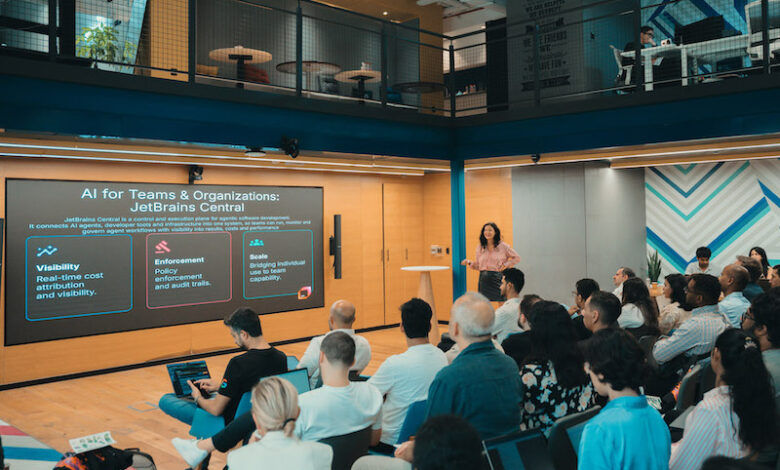
As Agentic AI rapidly moves from pilot to production, FinTech organisations must establish the engineering practices needed to build safe agentic systems at scale if they are to succeed in the highly competitive sector, according to experts at a recent event at the FinTech Hive, DIFC Innovation Hub.
The event, ‘From Pilot to Production: Building the Foundations for Agentic AI in MENA FinTech’, brought together leaders from JetBrains MENA, Tabby, and Google for Developers. Speakers tackled the foundational challenges of deploying agentic AI at scale, focusing on modern engineering workflows, rigorous evaluations and testing, and navigating the critical transition from passive developer assistance to supervised autonomy.
The UAE’s Fast-Tracking AI Adoption
The discussion comes as the UAE continues to strengthen its position as a global leader in AI adoption, backed by ambitious government frameworks accelerating the deployment of new technologies across public and private sectors. The momentum is already visible on the ground: according to the most recent Dubai Financial Services Authority’s AI survey, more than half of authorised firms within DIFC are already using AI – up from one-third the previous year – with generative AI adoption nearly tripling over the same period.
As financial institutions embrace increasingly autonomous AI capabilities, leaders agreed that success will depend not only on the sophistication of AI models. It requires a robust foundation of developer tooling, mature software infrastructure, and – most critically – retaining human-in-the-loop control as the absolute bottleneck of AI expansion.
Nadia Rinsky, Head of MENA GTM, JetBrains, commented: “The UAE FinTech sector is uniquely positioned to benefit from progressive regulation and a thriving ecosystem, but as we scale agentic AI, we must confront a fundamental reality: accountability cannot be delegated to a machine, because AI has nothing to lose. When production breaks in a critical financial system, the human developer still gets the call. For JetBrains, the real progress isn’t just about cheap code generation; it’s about code control. The developer’s role is shifting toward directing, supervising, and verifying teams of intelligent agents. Our focus is providing the professional tools that act as an immune system against AI-generated complexity, ensuring engineers can confidently sign off on the code they merge.”
Moving From Individual Hype to Enterprise Scale
During the discussions, JetBrains shared its framework for how organizations can navigate the transition from individual, fragmented AI experiments to a structured, team-wide capability. Drawing on its 25-year legacy in code intelligence, the company highlighted that tools like JetBrains Central serve as a vital control plane for modern engineering teams. Rather than acting as a restriction, centralized governance – encompassing model policy enforcement, precise cost attribution, and workflow auditability – is the very safety system that empowers developers to move faster and scale AI sustainably.
Complementing this perspective, regional leaders shared practical execution strategies.
Tabby provided a real-world look at deploying AI agents within one of the region’s largest shopping and financial services apps, demonstrating how autonomous systems can drive tangible operational efficiency while operating strictly within the guardrails of financial regulation.
Denis Sakhnoc, Head of AI Agent Platform, Tabby, underlined the importance of focusing on operations, AI customer-facing products, and the software development lifecycle when implementing AI centred products. In FinTech, agents can assist with anti-fraud, Know Your Customer (KYC), customer support and other repetitive work, all of which are good candidates for automation, providing there are still processes for human-led approval and evaluation.
Majid Jamaah, Head of Cloud & DevOps, Beyond AI and Google Developer expert mapped out the enterprise-scale infrastructure required to host and run generative and agentic AI, detailing the resilient architectural designs necessary to turn fragile proofs-of-concept into reliable production pipelines. Among the key lessons shared were the importance of designing for variability, traffic, cost and latency, and the importance of starting with simple approaches and scaling up as real usage teaches companies where the limits are.