Unilever launches New Production Line in Saudi Arabia
Reinforcing the Kingdom’s position as a regional home care manufacturing and export hub
Jeddah – Asdaf News:
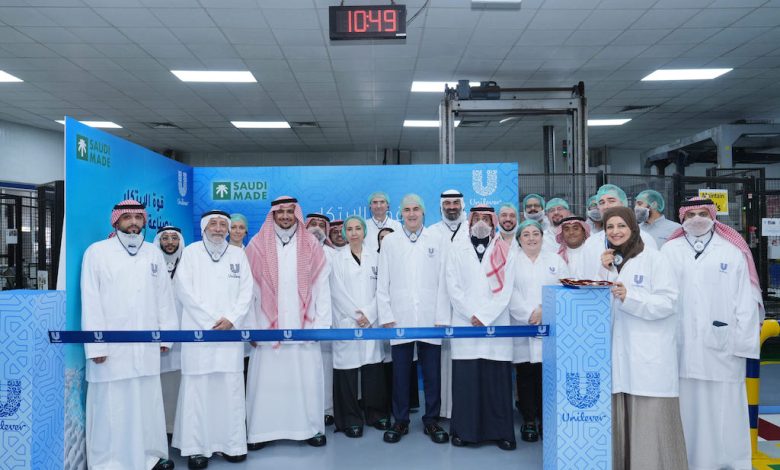
Earlier today, Unilever marked the expansion of its Home Care manufacturing operations in Saudi Arabia, which now includes OMO Liquid detergent production at its Binzagr Unilever Limited (BUL) factory in Jeddah, marking a significant milestone in the company’s ongoing investment in advanced, sustainable manufacturing in the Kingdom. The inauguration took place in the presence of senior representatives from government and industry, reflecting the strategic importance of the expansion in supporting Saudi Arabia’s industrial diversification and non-oil export ambitions.
Eng. Saad Alshareef, the Assistant Deputy minister for Sectorial Development at Ministry of Industry and Mineral Resources, said: “Saudi Arabia’s industrial sector has been a cornerstone of the economy for decades. In recent years, we have elevated our production services focusing on offering world-class, advanced, high-value manufacturing. By integrating technology, localization, and export capabilities as demonstrated by Unilever, this investment contributes to building a resilient industrial base, which supports economic diversification and strengthens the Kingdom’s competitiveness within global supply chains.”
Designed as a state-of-the-art, digitally enabled facility, the new OMO Liquid line will also act as a Middle East hub, with more than half of production confirmed for export to regional markets and the rest serving local demand. The expansion positions Saudi Arabia as an export base for high-quality home care products, directly contributing to the Kingdom’s non-oil export growth in line with Saudi Vision 2030 and the National Industrial Strategy.
Ali Fuat Orhonoğlu, Home Care General Manager, Unilever Pakistan, Türkiye, GCC and Bangladesh, said: “Our investment in advanced technologies and sustainable production to produce our much-loved OMO Liquid detergent in Saudi Arabia reflects how we are rethinking manufacturing to support the country’s next phase of industrial growth as part of Saudi Vision 2030. We are prioritizing embedding advanced technology and building resilient local supply chains to service the region from our hub in Saudi Arabia. It reinforces our long-term commitment to the Kingdom as a regional center for Unilever’s high-quality, sustainable home care manufacturing.”
The OMO Liquid formula has been developed to meet local consumer needs, including effective performance on abaya fabrics and suitability for regional water conditions, while incorporating global best-in-class technologies. The product is manufactured using recyclable PE bottles and biodegradable ingredients, aligning with Unilever’s global sustainability commitments and its ambition to achieve net zero emissions across its value chain by 2039.
The expansion builds on a strong track record of operational excellence at the BUL factory, which has achieved zero waste to landfill since 2015, implemented energy-efficient systems including solar power for office operations, and received multiple national and regional recognitions for sustainability and digital transformation.
By localizing production and sourcing key inputs such as petroleum-based materials and packaging domestically, the project strengthens national supply chains, increases local opportunities, and reduces reliance on imports. The launch underscores Unilever’s long-standing presence in Saudi Arabia, which began in the 1930s and formally evolved into local manufacturing through the Binzagr–Unilever joint venture in 1978. Today, the Jeddah facility serves more than 26 countries across five continents and stands as one of Unilever’s key regional manufacturing hubs.
The OMO Liquid launch represents the latest chapter in Unilever’s industrial journey in Saudi Arabia, following recent expansions including JIF spray production and the Kingdom’s first deodorant stick manufacturing lines. Together, these investments demonstrate Unilever’s enduring partnership with Saudi Arabia and its continued contribution to industrial development, sustainability, and economic diversification.